 admin@medicalduniya.in
 +91 9625527921
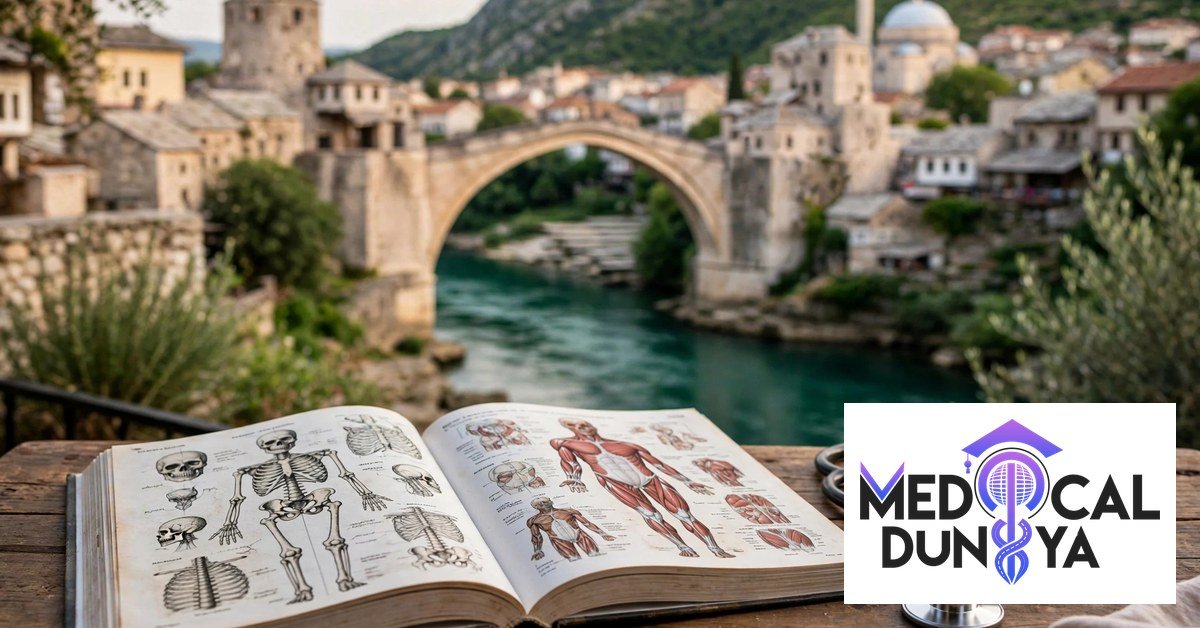
Last year, a mother from Lucknow called me in tears. Her son had qualified NEET and dreamed of becoming a doctor, but their family could not afford a private medical seat in India. Someone had suggested MBBS in Bosnia, and she had two questions — is the degree real, and will her son be safe so far from home? I told her what I tell every parent: the degree is real if you choose correctly, and safety comes from choosing a proper university in a proper city, not from a brochure’s promises. This guide answers both questions properly.
Bosnia and Herzegovina is one of the quieter names in MBBS abroad, and that is exactly why families who find it tend to like it. The course is a six-year MD programme taught in English, including the internship year. The country is small, the cities are calm, and the medical universities have been training international students for years. But a lesser-known destination also means you must be more careful — there is less crowd wisdom to rely on, so your own checking matters more. This guide will walk you through the duration, the degree, the eligibility rules, the admission process, the documents, the costs, student life, and the road back to practising in India.
Why Indian Students Choose MBBS in Bosnia
The first reason families consider Bosnia is the structure of the course. Six years, including internship, MD degree, English medium — it lines up with the National Medical Commission’s requirements for foreign medical graduates without any complicated adjustments. When a course fits the rules cleanly, half your worries disappear.
The second reason is the setting. Bosnia’s medical universities are located in cities like Sarajevo, the capital — historic, compact, and easy to live in. The pace of life is slower than in India’s big cities, and for a student carrying a heavy medical syllabus, a calmer environment is genuinely helpful. You can walk to most places, public transport is straightforward, and daily life does not drain you the way a chaotic metro does.
The third reason is the size of the Indian student community. It is smaller than in some of the more popular destinations, which has two sides to it. On the one hand, you will not find an Indian restaurant on every corner. On the other hand, students tend to bond closely, seniors genuinely look after juniors, and the community is tight-knit rather than scattered. Many families tell me their children found a second family among their batchmates in Bosnia.
Course Duration and Degree: What You Actually Study
The MBBS course in Bosnia runs for six years, including the internship year, and the degree awarded is MD (Doctor of Medicine). This is the standard medical degree in Bosnia and in most of the countries Indian students choose for MBBS abroad.
The duration matters for one specific reason. The National Medical Commission requires Indian students studying medicine abroad to complete a minimum of 54 months of study plus 12 months of internship. A six-year programme that includes the internship satisfies this requirement, as long as the course is in English medium and the university is recognised. Before anything else, I always check this structure with a family: how many months, in what language, and how the internship is arranged.
Eligibility and Admission Process: NEET Is Non-Negotiable
Let me say this as plainly as I can, because it is the rule that causes the most heartbreak when it is ignored: every Indian student who wants to study MBBS outside India must qualify NEET. There is no exception and no agent who can get around it. Without a qualifying NEET score, you cannot get the eligibility certificate, and you cannot sit for the licensing exam when you return to India. If anyone tells you NEET is not needed, do not believe them.
Alongside NEET, you need to have completed Class 12 with Physics, Chemistry and Biology, with the minimum marks prescribed by the NMC. Once those two conditions are met, the admission process itself is straightforward.
Step 1: Check Your Eligibility
Start by confirming you meet the NMC’s conditions — NEET qualified, Class 12 with the required subjects and marks, and a course that meets the duration and language rules. This is a short check, but it is the most important one in the whole journey.
Step 2: Apply to the University
With eligibility confirmed, you apply to the university with your academic documents. Universities generally respond with an admission or invitation letter if your documents are in order.
Step 3: Receive the Invitation Letter
The university issues an invitation or admission letter. Check that your name and passport details on it match your passport exactly — even a small spelling difference can delay your visa.
Step 4: Apply for the Student Visa
With the invitation letter, you apply for a student visa at the Bosnian embassy or consulate. You will need your passport, the invitation letter, academic documents, and proof of funds. Start this process early.
Step 5: Travel and Enrolment
Once your visa is stamped, you travel to Bosnia, complete enrolment and the medical check-up formalities, and settle into your hostel.
Documents to Keep Ready Before You Apply
Keep a folder — physical and digital — ready before you begin. It saves weeks of last-minute running around.
- Valid passport (with enough validity to cover your course)
- NEET scorecard showing you have qualified
- Class 10 marksheet and certificate
- Class 12 marksheet and certificate (Physics, Chemistry, Biology)
- Birth certificate
- Passport-size photographs (keep at least a dozen)
- Medical fitness certificate, as required by the university or visa process
- Police clearance certificate, if asked for
- Bank statements or proof of funds, for the visa application
Check that the name and date of birth on every document match your passport exactly. A name spelt one way on a marksheet and another way on a passport is one of the most common causes of delay, and correcting it takes time you will not have once deadlines arrive.
Fees and Living Costs: What to Budget For
Every family asks me for a number, and I give the same honest answer every time: fees vary by university and change from year to year. A figure printed in this guide could be wrong by the time you apply. What I can tell you is what to budget for, so nothing catches you by surprise.
Tuition is the biggest cost and is usually paid annually. Confirm the current fee structure in writing from the university before applying, ask what it includes, and ask whether it is fixed for the full course or revised each year. Some universities include hostel and insurance in the fee; others charge separately — know which one you are dealing with.
Living costs in Bosnia are moderate. Your recurring expenses will be hostel or apartment rent, food, local transport, mobile and internet, books, and health insurance. Sarajevo and other university cities are smaller and cheaper to live in than the big capitals of Western Europe. Many Indian students cook together in groups, which keeps food costs down, and Indian groceries can be found in the larger cities, though you may need to plan ahead more than you would in a bigger Indian community abroad.
Student Life in Bosnia
Bosnia and Herzegovina is a country of mountains, rivers, and old towns — and its capital, Sarajevo, is a city where different cultures have lived side by side for centuries. For an Indian student, the first impression is usually how peaceful daily life feels. The cities are compact, people are warm, and the rhythm of life is unhurried.
The Indian student community in Bosnia is smaller than in the most popular MBBS destinations, and that shapes student life in a good way. Students know each other, seniors help juniors settle in, and festivals are celebrated together even if the gatherings are smaller. Most universities provide hostel accommodation, and students often move to shared apartments with friends after the first year or two. Learning a few words of Bosnian helps in everyday life — in shops, on buses, with neighbours — even though your classes are entirely in English.
FMGE/NExT and Practising in India After MBBS in Bosnia
This is the part that decides whether your degree is worth anything back home, so read it carefully. After completing MBBS abroad, you must clear the Foreign Medical Graduate Examination (FMGE) — which is being transitioned to the National Exit Test (NExT) — to get a licence to practise medicine in India. This applies to every Indian student who studies medicine abroad, in every country.
Your eligibility for this exam depends on your course meeting NMC requirements: at least 54 months of study plus 12 months of internship, in English medium, from a recognised university, with NEET qualification before admission. Bosnia’s six-year MD programme in English is structured to meet these conditions — but it is your responsibility to verify that the specific university you choose meets them.
After clearing the exam, you register with the state medical council and can practise in India, or appear for NEET PG for postgraduate studies, like any other Indian medical graduate.
Common Mistakes to Avoid When Planning MBBS in Bosnia
Applying without qualifying NEET. This is the most expensive mistake in MBBS abroad. Without NEET qualification, your degree cannot lead to a licence in India. No agent, no university, no shortcut changes this.
Choosing a university without checking NMC rules. Bosnia is a lesser-known destination, which makes this check even more important. Verify the university against NMC requirements on duration, language and internship before you pay anything.
Trusting a fixed fee from an old brochure. Fees change. Confirm the current structure in writing, ask what is included, and budget for annual revisions.
Ignoring the internship year. Ask before admission exactly where and how the internship is done, and whether it satisfies NMC requirements. Do not discover the answer in your sixth year.
Starting licensing exam preparation too late. The FMGE/NExT is not an exam you clear with three months of revision after six years of studying differently. Prepare alongside your course from the early years.
Frequently Asked Questions
Is the MBBS degree from Bosnia valid in India?
Yes, provided the course meets NMC requirements — a minimum of 54 months of study plus 12 months of internship, in English medium, from a recognised university, with NEET qualification before admission.
Is NEET mandatory for MBBS in Bosnia?
Yes. Every Indian student studying MBBS abroad must qualify NEET. Without it, you cannot obtain the eligibility certificate and cannot sit for the licensing exam on your return.
What is the duration of MBBS in Bosnia?
The course is six years, including the internship year. The degree awarded is MD.
Is the course taught in English?
Yes, the MBBS course for international students in Bosnia is taught in English medium.
Can I practise in India after completing MBBS in Bosnia?
Yes.
Final Word: A Quiet Destination Worth a Serious Look
Bosnia will not be the first name most families hear when they start researching MBBS abroad, and that is not a weakness — it is simply a quieter destination. What it offers is real: an English-medium MD, a six-year structure that fits NMC rules, calm and affordable cities, and a close-knit student community. But a quieter destination also demands more care from you. Check the university against NMC requirements, confirm the fees in writing, and understand the licensing exam before you commit.
If you are considering MBBS in Bosnia, talk to us before you apply anywhere. Bring your NEET scorecard, your Class 12 marksheet, and your questions. Medical Duniya will help you check your eligibility, choose a university that meets the rules, prepare your documents, and plan the whole journey — so that the day you leave, you leave with confidence, not confusion.